How to Structure Your Kids' Day at Home (Without Losing Your Mind)
Kids home all day and you've already heard "Mummy I'm bored" ten times before lunch? Here's the simple 5-block day structure that saves your sanity without spending money!

By iMumZone | imumzone.com
"Mummy, I'm bored."
You've heard it ten times today and it's not even lunchtime.
If your kids are home all day, whether it's a school holiday, a public holiday, or just one of those long unplanned days, the secret to keeping your sanity isn't spending money or planning the perfect activity. It's structure.
Not a rigid timetable. Not a Pinterest-perfect schedule. Just a simple, repeatable rhythm that gives your children something to move through and gives you breathing room.
Here's exactly what works.
Why Structure Matters More Than Activities
When kids don't know what's coming next, they come to you to fill the gap. That's where the "Mummy I'm bored" loop starts.
A loose daily structure solves this. When children can anticipate what's happening next, even roughly, they settle more easily, argue less, and are actually more creative during their free time.
And here's the truth: you don't need anything expensive. No pressure, no perfect schedule. Just consistency.
The 5-Block Day That Actually Works
Think of the day in five simple blocks rather than a minute-by-minute schedule. You can shift these around to suit your household, but the five pillars stay the same.
1. Learning Time (30 mins)
Don't just let them "figure it out." Give the morning a purpose with a short, low-pressure learning block.
Ideas:
- Duolingo Free app to learn a new language. Even 10 minutes a day adds up. Available for kids as young as 3 with the ABC app.
- YouTube Kids Search for documentaries about a new country, animal, or topic. Turn screen time into curious time.
- Khan Academy Kids Free learning for ages 2 to 8. Covers maths, reading, and more. Works anywhere in the world.
- BBC Bitesize Great for curriculum topics and accessible globally online.
- Inspired by Naijahood YouTube channel with African-centred learning content for kids.
- Reading Even 15 minutes of independent book reading counts. Keep a small stack of age-appropriate books within reach.
💡 Tip: Don't sit with them for this. Set it up, explain it once, and let them get on with it. This is independent time.
2. Skill Time
This is the one that Nigerian mums will understand deeply. We don't raise children who can't do anything for themselves! Skill time builds independence and character, even when it's a little messy.
Ideas:
- Fold clothes (even if it's imperfect, let it be)
- Wash their own plate after meals
- Help in the kitchen: stirring, measuring, laying the table
- Water a plant
- Pack their own snack bag
Messy, but worth it.
No, their folded pile won't look like yours. Yes, they'll get water on the floor. That's the point. Skills are built through practice, not perfection.
3. Quiet Time
This is the block most mums skip and the one they need most.
Quiet time is your gift to yourself. And honestly, children benefit from learning to be still too.
Ideas for kids:
- Nap (for younger ones)
- Independent play with no screens and no input from you
- Drawing or colouring
- Building with Lego or blocks
- Puzzles
What you do during quiet time: Whatever you need. Rest. Work. Drink your tea while it's hot. Scroll in peace. You need this too.
💡 Start with 20 minutes and build up. The first few times, they'll test it. Hold the boundary gently.
4. Fun Time
Let them be children. This is the block where they lead.
Ideas:
- TV or a favourite show
- Board games or card games
- Play outside: garden, park, or just the compound
- Creative play: dress-up, dolls, cars, imaginative worlds
- Arts and crafts
Let them enjoy being kids. Not every moment needs to be educational. Play is learning at this age.
5. Responsibility Time
Close the day with a responsibility block. This teaches children that being part of a household means contributing to it, not just receiving from it.
Ideas:
- Pack away their toys before dinner
- Help tidy the living room
- Small daily tasks: wiping a surface, putting shoes away, helping set the table
- Prepare their school bag for the next day
Real Life: How I Structure My Boys' Days
I have two boys, and one thing I've found invaluable on days when they're home is a physical checklist board.
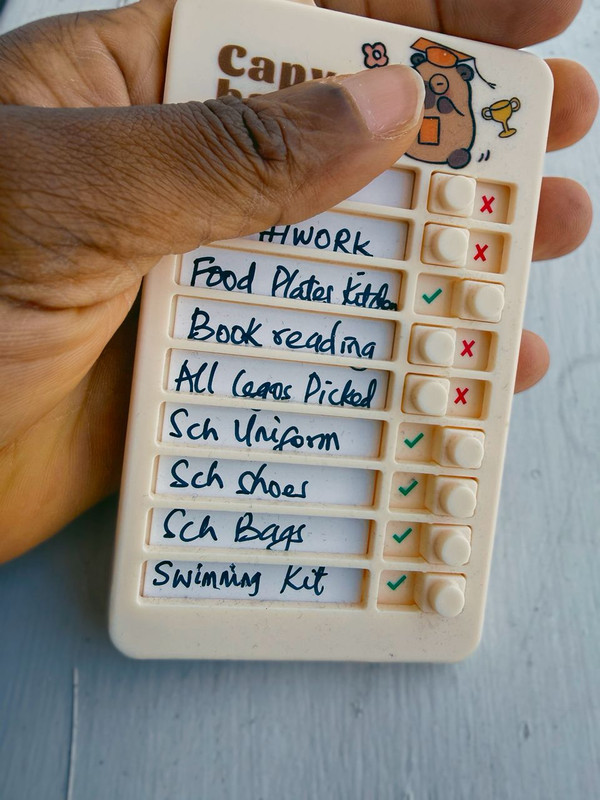
This little board sits somewhere visible and has their daily tasks listed out, from school prep items to responsibilities like reading and kitchen help. They can see exactly what's expected, and there's something satisfying about ticking things off (even when half of them end up with a red X 😄).
Some of what's on ours:
- Homework ✅
- Food, plates, kitchen ✅
- Book reading
- All Legos picked up
- School uniform ready ✅
- School shoes ✅
- School bags ✅
- Swimming kit ✅
Does this work for mums with toddlers? Yes, with a small tweak. Your toddler won't use the board independently, but you can use it to track the day's rhythm. And older siblings can take ownership of their own checklist, which actually reduces the load on you.
You can find reusable checklist boards like this on Jumia (Nigeria), Amazon, or at local stationery and children's stores. Search for "kids chore board" or "kids responsibility chart."
Helpful Resources for Home Days
Here's everything in one place.
Free Learning Apps and Websites
| Resource | Best For | Link |
|---|---|---|
| Duolingo | Languages (ages 5+) | duolingo.com |
| Duolingo ABC | Early reading (ages 3 to 6) | duolingo.com/abc |
| Khan Academy Kids | Maths and reading (ages 2 to 8) | khanacademy.org/kids |
| BBC Bitesize | Curriculum topics (all ages) | bbc.co.uk/bitesize |
| YouTube Kids | Educational videos (all ages) | youtubekids.com |
| Starfall | Phonics and early reading (ages 3 to 8) | starfall.com |
| Funbrain | Games and reading (ages 3 to 8) | funbrain.com |
Screen-Free Activity Ideas
- Red Ted Art Easy craft ideas for kids with minimal supplies, works anywhere
- Activity Village Free printable activities by theme and age, print from anywhere
- Twinkl Printable worksheets and colouring pages (free basic access)
Books to Keep on Rotation
- A mix of picture books, early readers, and non-fiction fact books works well
- Look for books that celebrate African culture and identity. Representation matters.
- Oxford Owl Free ebooks for children aged 3 to 11, accessible globally
Physical Products
- Kids chore or responsibility boards: search on Jumia, Amazon, or your local stationery store
- Visual timers: brilliant for younger children to understand time blocks
- Colouring and activity books: widely available and inexpensive
The One Thing to Remember
You don't need anything expensive.
No pressure. No perfect schedule.
Just consistency. Showing up with a loose rhythm, day after day, is what makes the difference. Some days will flow beautifully. Others, you'll abandon the plan by 10am and that's okay too.
You're doing brilliantly, mama.
Did this help? Save this post for the next home day and share it with a fellow mum who needs it.
For more practical parenting tips and resources, follow us at @iMumZone and visit imumzone.com
Comments(0)
Join the conversation — log in to leave a comment.
Log in to comment- Be the first to comment.
Talk about this with other mums
Have a question or something to share? Start the conversation on MumChat.
Start a conversation about thisNever miss a new post
Get an email the moment we publish something new. No spam, unsubscribe in one click.


