Mosquito Season and Resumption: Protecting Your Child Before School Starts
Simple, practical ways Nigerian parents can protect their children from mosquitoes before school resumes, recognise possible malaria symptoms, and know when to test and seek medical care.

Mosquito Season and Resumption: Protecting Your Child Before School Starts
Most Nigerian homes have it somewhere. Half a pack of malaria medicine in a drawer or a handbag, left over from the last time a child was ill. It sits there quietly until the next fever arrives, and then it becomes very tempting.
Please do not use it. That is probably the single most useful thing in this article, and we will come back to why.
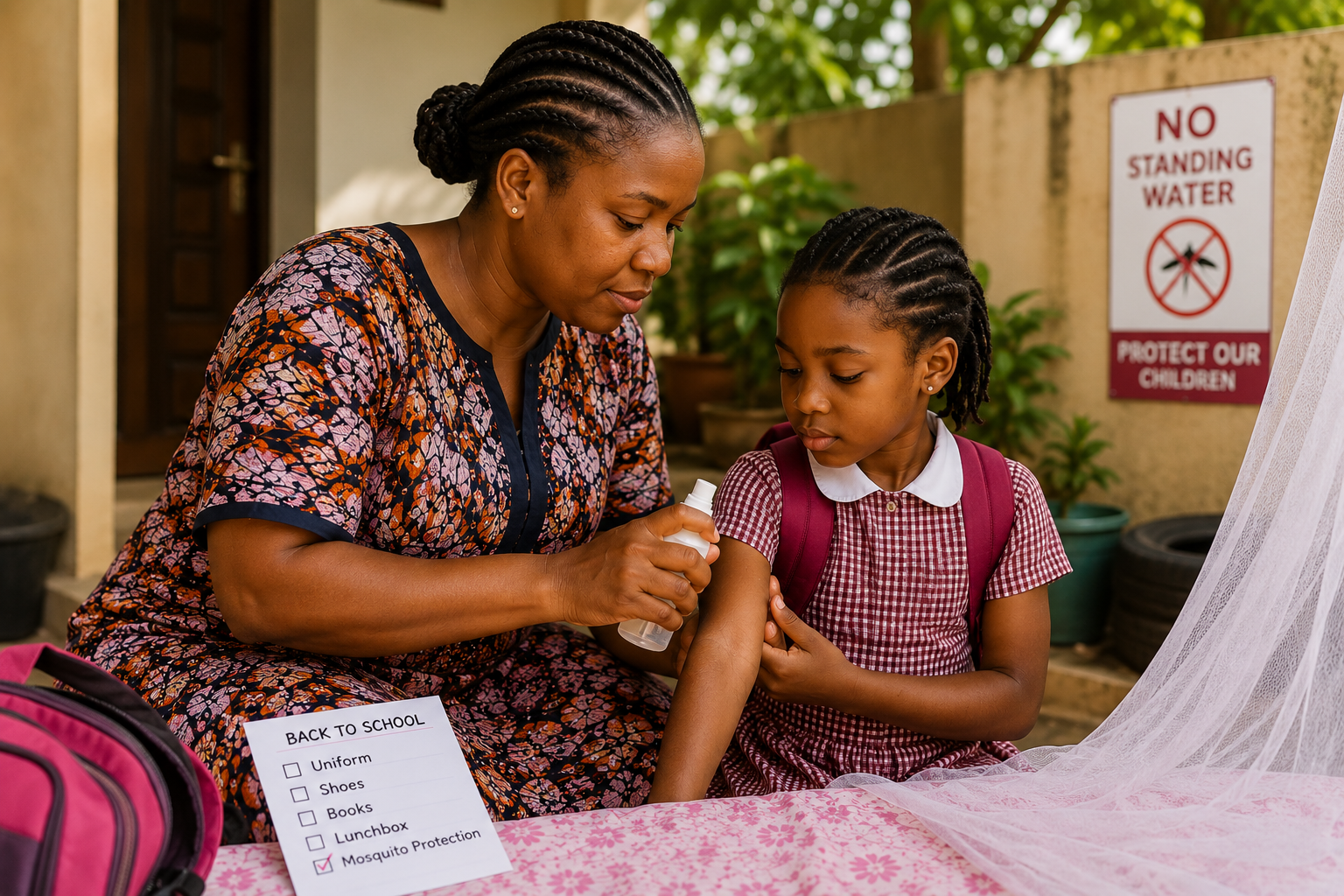
School resumption brings a long list. Uniforms, shoes, books, lunchboxes, bedtimes to drag back into shape after the holidays. Mosquito protection almost never makes that list, even though your child is about to spend six or seven hours a day somewhere you have never inspected for standing water.
Malaria is preventable and treatable. Children under five are more likely than older children and adults to become seriously ill from it, which is why they are worth a little extra attention. With World Mosquito Day on 20 August, this is a good week to look around.
You do not need to panic, and you do not need a mosquito-free house. A few small habits do most of the work.
Check the net before the term starts
Take the net down and hold it up to the light. You are looking for holes, thin patches and tears along the seams, which is usually where they start.
If you find a small hole, stitch it or patch it rather than leaving it. A hole is an open door. If the net is badly torn, or if it is an insecticide-treated net that is more than about three years old, it is worth replacing. Treated nets lose their effectiveness over time, and a net that has been washed many times will not be doing what it did when it was new.
Then check how it is actually being used, which matters as much as its condition. It should cover the whole sleeping area and be tucked in, with your child sleeping fully inside it rather than with an arm or a leg pressed against the mesh or half the net left open through the night.
If your child still naps during the day in a room where mosquitoes gather, that nap is worth protecting too.
Repellent, and how to choose one
Repellent is useful when your child is outdoors, especially in the evening.
The confusing part is choosing. A repellent that is fine for you is not automatically fine for a small child, and the label is where the answer is. Look for the active ingredient and the age guidance printed on the pack, and if you cannot find clear age guidance, ask the pharmacist before you buy rather than guessing in the aisle. Take your child’s age with you.
When you use it:
Long sleeves and long trousers in the evening do a quiet amount of work too, when the weather makes that comfortable.
None of this means keeping children indoors. They should still be outside playing. It is just a few sensible layers.
Walk your compound before resumption
Take ten minutes and walk around. Most people are surprised by how much water is sitting in places that were never meant to hold it.
Old tyres. Buckets. Flowerpot saucers. Empty bottles and tins. Blocked drains and gutters. Anything holding water that does not need to hold water should be emptied and turned over so it does not fill again with the next rain. Keep stored water covered.
It is a small job, and during the rainy season it is worth doing regularly rather than once.
The school compound matters too, and you have not seen it. You do not need to make it a whole conversation. A simple question at drop-off about how the school handles blocked drains and standing water is enough, and if a few parents ask, it tends to get attention.
What malaria can look like in a child
The difficulty is that early malaria looks like a great many other childhood illnesses.
A child may have fever, chills or a headache. They may go off their food, become unusually tired, or complain of body weakness. Some vomit. Often the first thing a parent notices is not a symptom at all, just that the child is not behaving like themselves.
Trust that. You know your child’s normal better than anyone does, and a noticeable change in behaviour alongside a fever is worth acting on.
At the same time, fever is not proof of malaria. Children run fevers for many reasons, which is exactly why the next part matters.
Test rather than guess
It is easy to think, fever means malaria, because in Nigeria malaria is common enough for that to be a reasonable guess. But a guess can mean treating the wrong illness while the real one continues.
If you suspect malaria, take your child to a healthcare provider and ask for a malaria test. The World Health Organization recommends that suspected cases are confirmed with a parasite-based test, either a rapid diagnostic test or microscopy, before treatment is given. A rapid test is quick and inexpensive, and it turns a guess into an answer.
This does not mean every fever needs to become an ordeal. It means you get clarity before you medicate, instead of working through whatever is in the drawer.
The leftover medicine
Which brings us back to the half pack. The treatment that was right months ago may not be right now. The correct malaria treatment can depend on the type of malaria and on your child’s age and weight, and children are exactly the group where getting the dose right matters most. An incomplete or wrong-dose course can also leave an infection partly treated. Get your child assessed and follow what the health professional tells you, even when the medicine sitting at home is familiar and free.
When it needs urgent attention
Most childhood fevers are manageable with proper advice. A few are not, and these signs mean going straight for urgent medical care rather than waiting to see how the night goes:
You do not need to be frightened by every fever. You just need to know the difference between a child who is mildly unwell and a child who needs to be seen now.
Add it to the back-to-school list
Alongside the uniforms and the books:
None of this has to be done perfectly. Small things, done consistently, make a difference, and they make the new term one less thing carrying weight in your head.
The goal was never to live in fear of mosquitoes. It is to give your child the protection you reasonably can, know what to watch for, and get help quickly when they need it.
A note from iMumZone
This article is general information and is not a substitute for advice about your own child. If your child has a fever or symptoms that concern you, take them to your nearest hospital, clinic or primary health centre and ask about malaria testing. If any of the urgent signs above appear, seek medical care immediately rather than waiting.
Comments(0)
Join the conversation — log in to leave a comment.
Log in to comment- Be the first to comment.
Talk about this with other mums
Have a question or something to share? Start the conversation on MumChat.
Start a conversation about thisNever miss a new post
Get an email the moment we publish something new. No spam, unsubscribe in one click.


